Word Search Puzzles
99 free word searches on themes from Halloween to Taylor Swift. Play online on any device, or print them with an answer key. Every puzzle comes in easy, medium, hard and large print.
Collections
 Large print word searches Every puzzle in a large print version: big letters, small grids and the 12 most familiar words.
  Hard word searches Every puzzle in a hard version: all the words, all eight directions and look-alike letters.
 In season now

















Holiday word searches
From Halloween and Thanksgiving to Christmas and Valentine’s Day, with vocabulary kids actually use that week.













Seasonal word searches
Fall leaves, snow days, spring rain and summer break, plus a first-week-of-school puzzle.
Word searches for every month
One puzzle for each month of the year, packed with that month’s holidays, weather and traditions.
Animal and nature word searches
Ocean life, dinosaurs, birds, bugs, weather and the solar system, each with notes that explain every word.







Food word searches
Fruit, vegetables, baking and everyday food words for hungry solvers.



Sports word searches
Football, basketball, baseball and soccer terms, from the end zone to the penalty box.


Pop culture word searches
Unofficial fan puzzles for Swifties, wizards, Disney lovers and a galaxy far, far away.







Places, cars and travel word searches
Car parts, ways to get around, all fifty states and countries of the world.


Word searches for school
Vocabulary practice for science, math, music, the human body, feelings, colors and more.












Bible word searches
People, places and books of the Bible for Sunday school, VBS and quiet afternoons.

Word searches for hobbies and parties
Birthdays, weddings, beach days, camping trips and the kitchen.




No puzzles match that search. Try a broader word, or make your own word search with exactly the words you want.
How to solve a word search
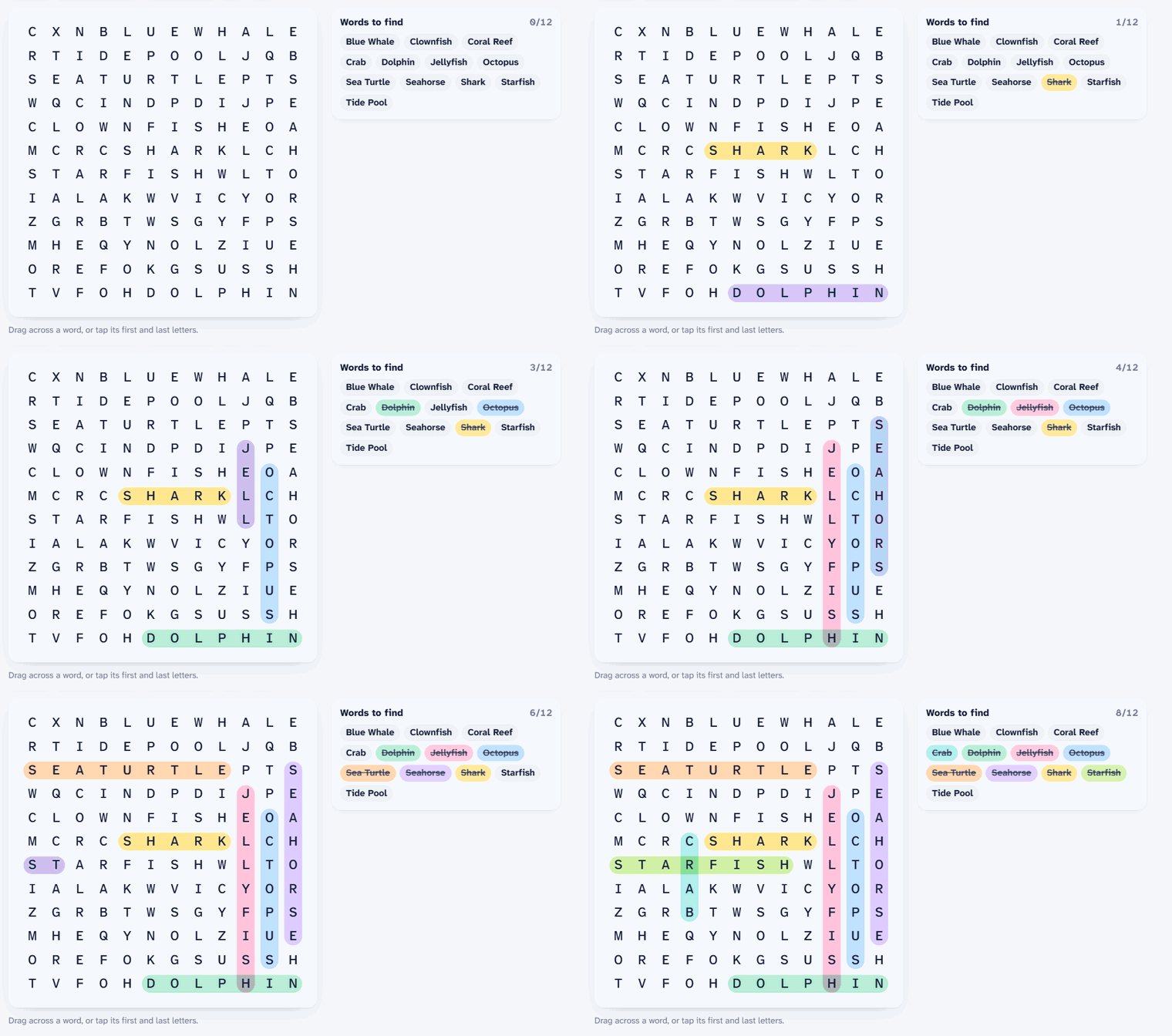
Every word in the list is hidden in the grid in a straight line. Depending on the level, words run across, down, diagonally, or backwards. Letters can be shared where two words cross. Here’s a real puzzle from this site being solved online:
Step by step
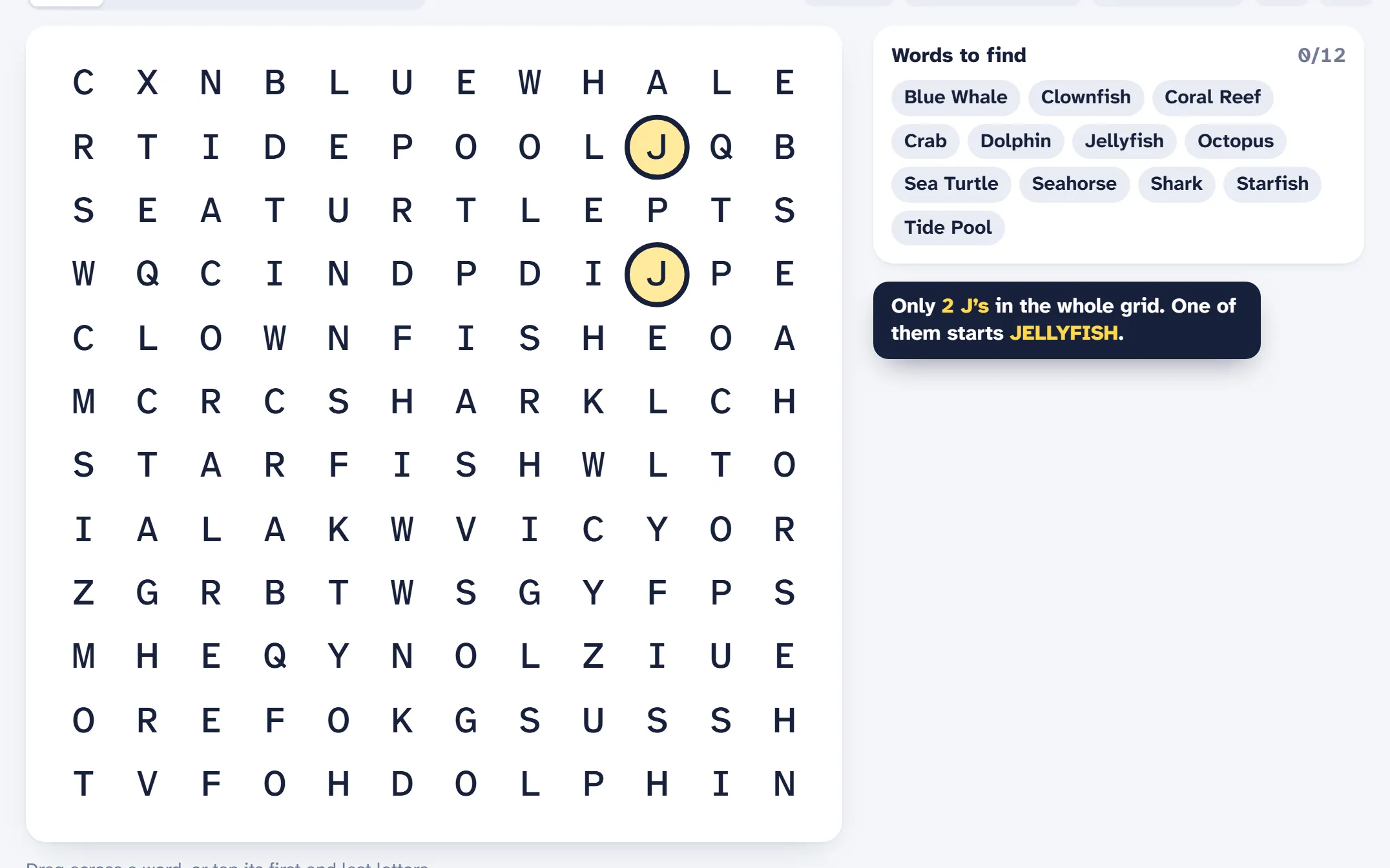
- Pick a word and look for its first letter. Start with long words or ones with unusual letters (J, Q, X, Z, K, V). There are fewer of those letters in the grid, so there are fewer places to check.
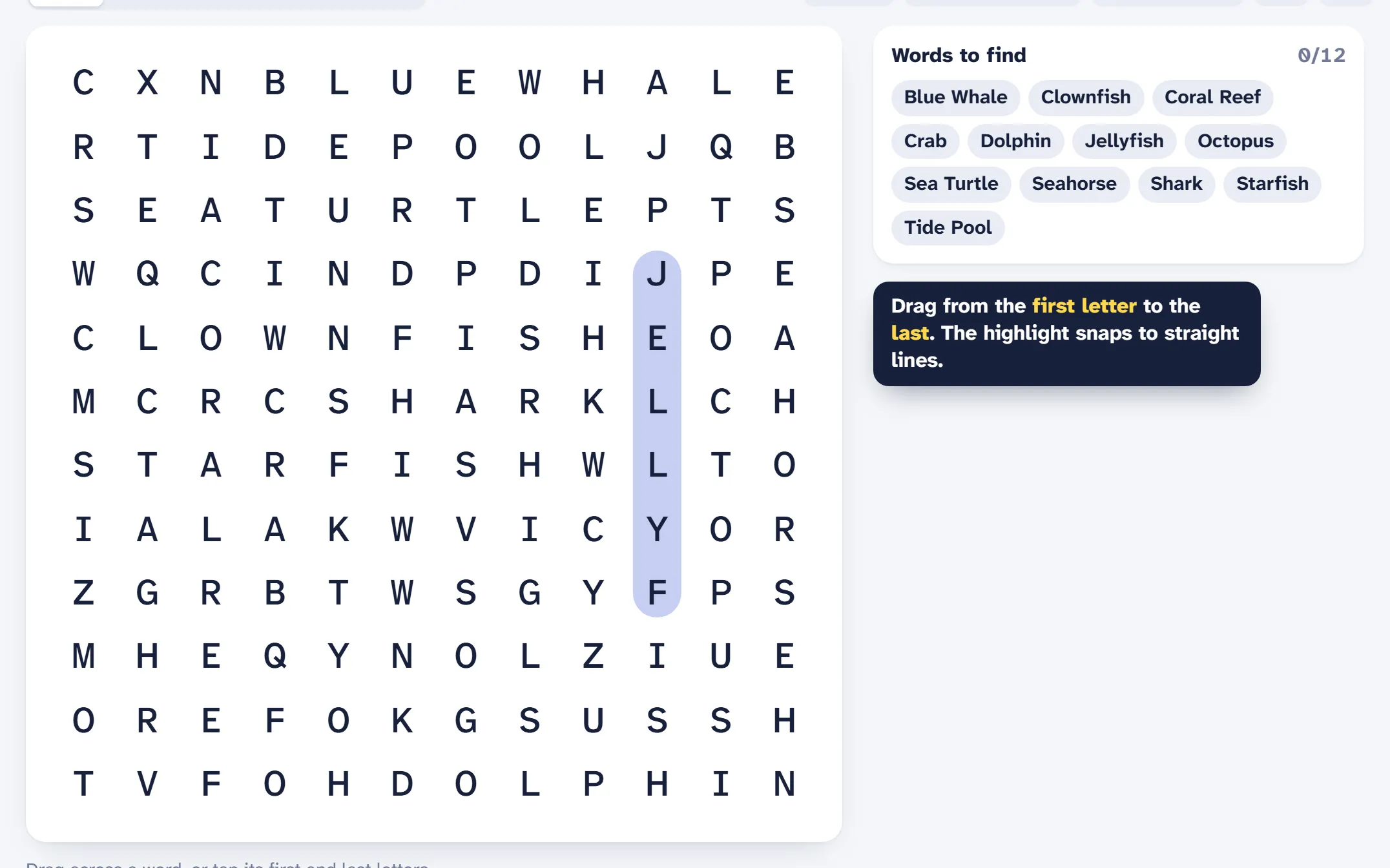
- Check the letters around it. When you spot the first letter, look at the eight letters touching it for the second letter. If you find it, follow that direction to see if the rest of the word continues in a straight line.
- Mark it and cross it off. Circle the word on paper, or drag across it online. Crossing it off the list keeps you from hunting for it twice.
Strategies that make big grids faster
- Hunt for double letters. Pairs like LL, EE or OO are easy to spot and narrow things down quickly for words that contain them.
- Search one row at a time. Run your finger along each row looking for a single target letter. It’s slower than scanning but never misses.
- Turn the page. Backwards and upward words are easier to see when you rotate the paper, because your eyes are used to reading left to right.
- Look for the end of the word too. If a word ends in an uncommon letter, search for that instead and read backwards.
- Save the short words for last. Three- and four-letter words hide easily among the filler, and once longer words are crossed off there’s less to search.
Playing online: hints, answers and your progress
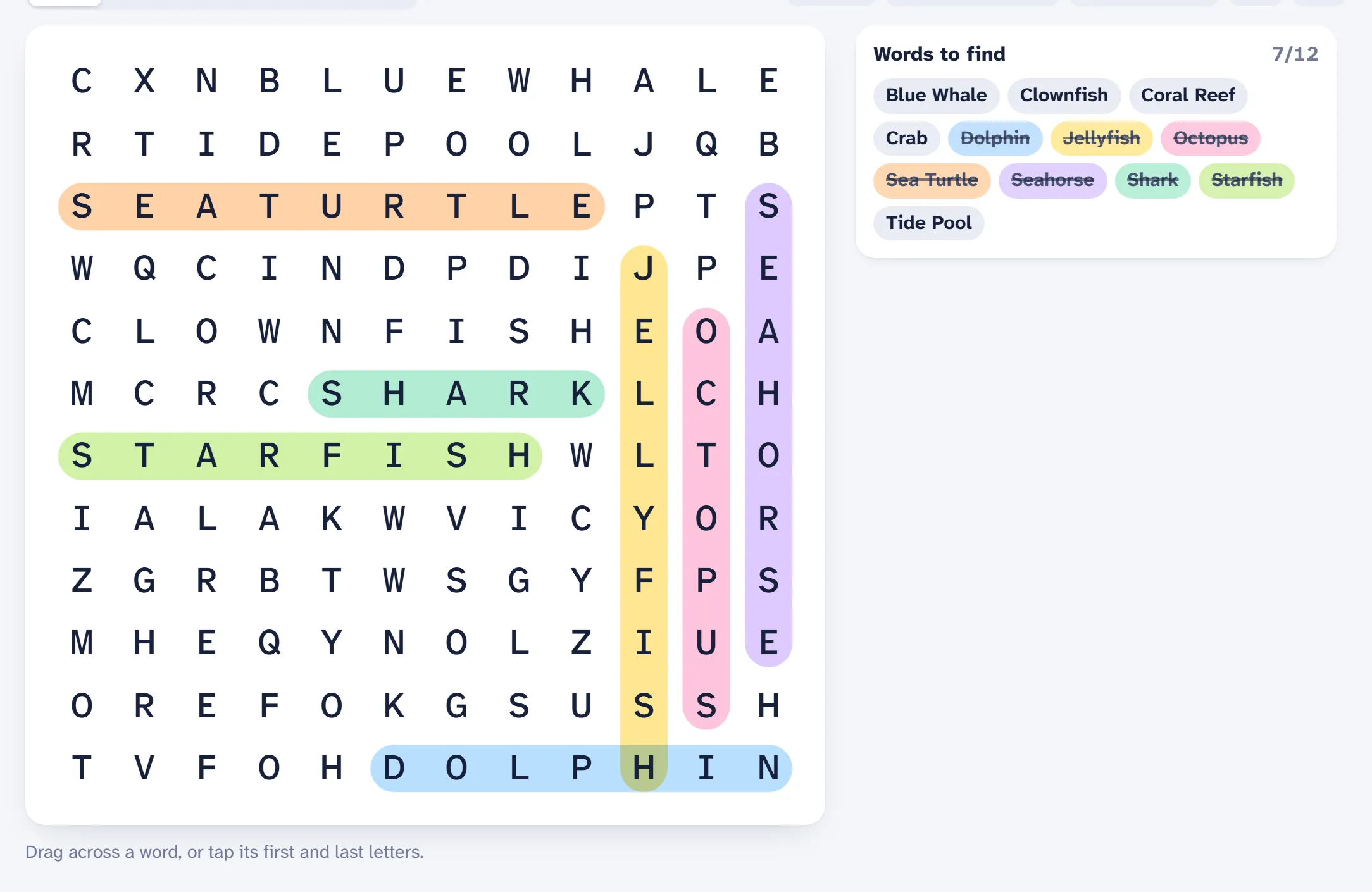
Hint circles the first letter of a word you haven’t found yet. Show answers draws an outline around every remaining word, which is useful for checking work. The timer starts on your first move and pauses when you switch tabs, and your progress is saved in your browser, so you can close the page and pick up later. Keyboard players can move around the grid with the arrow keys and press Enter on the first and last letters.
Can’t find your theme?
Make it yourself. The word search maker turns any list of words into a printable puzzle with an answer key in about a minute, and you can share a link so others can play it online.
Make a word searchWord search puzzle FAQ
Are these word search puzzles free?
Yes. All 99 puzzles are free to play online and free to print for personal, classroom, library and homeschool use. There’s no account to create.
Do the printable word searches come with answer keys?
Every puzzle has an answer key. Press Print / PDF on any puzzle and keep “Add an answer key page” ticked; the key prints on its own page with every word highlighted.
Which puzzles are best for kids?
Look for the Kids tag. Those puzzles open on the Easy level, where words only run forward across and down, and have shorter word lists. Any puzzle can be switched to Easy with the level buttons above the grid.
Can I play on a phone or tablet?
Yes. Drag your finger across a word, or tap its first and last letters. The grid resizes to fit your screen, and your progress is saved if you leave and come back.
Can I change the words in a puzzle?
Yes. Each puzzle page has an Edit in the maker button that opens its words in the word search maker, where you can add or remove words, change the size and shape, and print multiple versions.
Are word searches good for your brain?
Word searches exercise visual scanning, pattern recognition, spelling and sustained attention. They’re a relaxing way to practice concentration, and themed puzzles reinforce vocabulary, which is why teachers use them for new topics and spelling lists.